
The Pink RAZR
Almost the saviour of the human race.

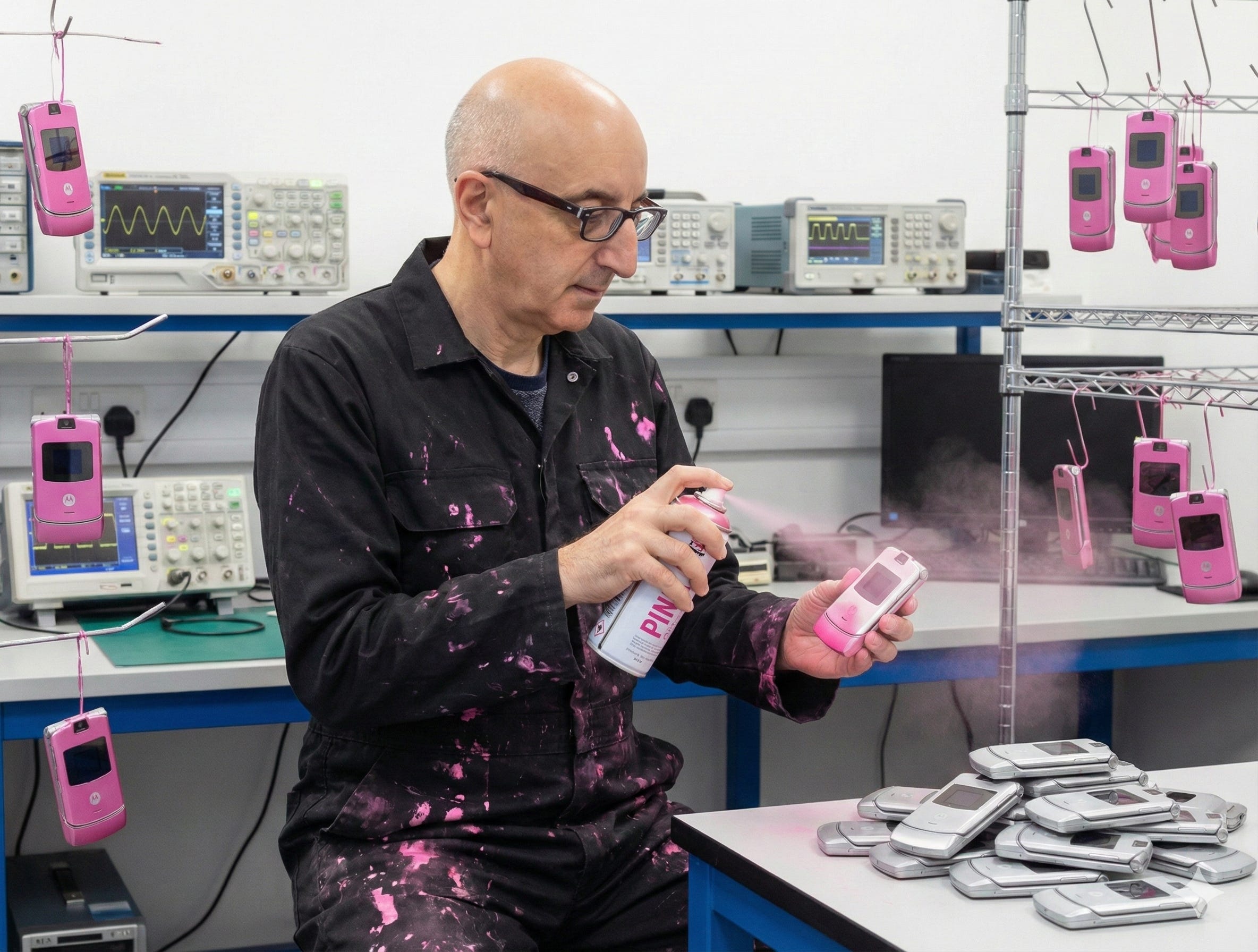
I was prompted to write this by a comment about pink Moto mouse mats from Pip Regan on LinkedIn, responding to my piece What Killed Motorola. Pip observed that Nick Buckland had insulated TTP.com from some of the worst excesses of the analysis paralysis that eventually strangled Motorola. Shielded, yes, but also obscuring. Hidden along with the spreadsheets and steering committees was something stranger, slipperier, and far more dangerous: Motorola’s long, awkward, unresolved relationship with the colour pink.
It has never been entirely clear to me, and I freely admit this may be a personal limitation rather than a universal truth, when women will react to a pink phone as thoughtful inclusion and when they will interpret it as pastel condescension. Pink as signal, pink as symbol, pink as synecdoche for an entire demographic. Engineers, of course, dislike ambiguity. Markets, of course, run on it.
One of the earliest attempts at a “phone for women” was the Samsung A400 “Ladyphone”, complete with its “Pink Schedule”.
The Motorola RAZR, by contrast, was emphatically not a phone “for women”. It was a man’s phone. A blade, not a bauble. Sharp chamfered edges, cold metal, click and snap and shut. It felt like a precision instrument and sounded like one too. You didn’t so much end a call as terminate it. Violence, but make it in aluminium. It was not a pink phone.
Women could have a PEBL. Soft curves, soft-touch coating, an object that looked like it might apologise if dropped. The taxonomy was clear: edge and curve, blade and pebble, him and her. Antithesis, rendered in plastic and paint. Very much a pink phone.
Which is why we were more than a little surprised when Charles Dunstone of Carphone Warehouse asked for the RAZR in pink.
Pink.
To be honest, we thought him slightly mad. This was unfair. Dunstone was, and remains, an absolute guru of retail psychology. He understood footfall and desire, aspiration and impulse, better than most people in the handset business understood radios. Still, the request landed like a wrong note. Pink RAZRs felt like a category error, a catachresis in anodised aluminium.
The minimum order quantity for a colour change was 100,000 units. Dunstone ordered 250,000 in pink. Bear in mind that the total forecast for RAZRs, across all colours, all channels, all markets, was 800,000.
Carphone Warehouse, it should be said, was not just another customer. It was one of the most important European accounts and the only major channel partner that was not a mobile operator. When Dunstone asked for pink exclusivity, we agreed. There is nothing more satisfying in a negotiation than conceding, with a flourish, something you secretly believe has no value at all.
Of course, Dunstone was right and we were wrong. Pink was a hit. Not a curiosity, not a novelty, but a runaway success. Carphone Warehouse went on to sell three million pink V3 RAZRs. Three million. Not bad for a colour the engineers thought was a joke.
I’ve always thought it was ironic that in Christmas 2004, Nokia had finally caught up with Motorola on 3G phones. A significant engineering effort, and we outsold them painting a phone pink.
And then the pink problems began.
Other customers wanted it. Especially T-Mobile, whose corporate colour is pink, though they insist on calling it “Magenta”, or #E20074 to its friends. We found ourselves in the unusual and faintly humiliating position of having to buy back the rights to a colour from our own customer.
The deal was eventually struck. Carphone retained exclusivity in its operating territories. Motorola could sell pink RAZRs elsewhere. Pride was swallowed. Pink, having been dismissed, returned as leverage.
Pink, Pip, has provenance at Motorola.
Moto was run by engineers. They don’t do pink. So not a surprise.
With all respect to Pip I think she might have been shielded from the Moto bull at TTPCom but I certainly wasn’t.