
What Killed Motorola
Loss of a leader and leadership.

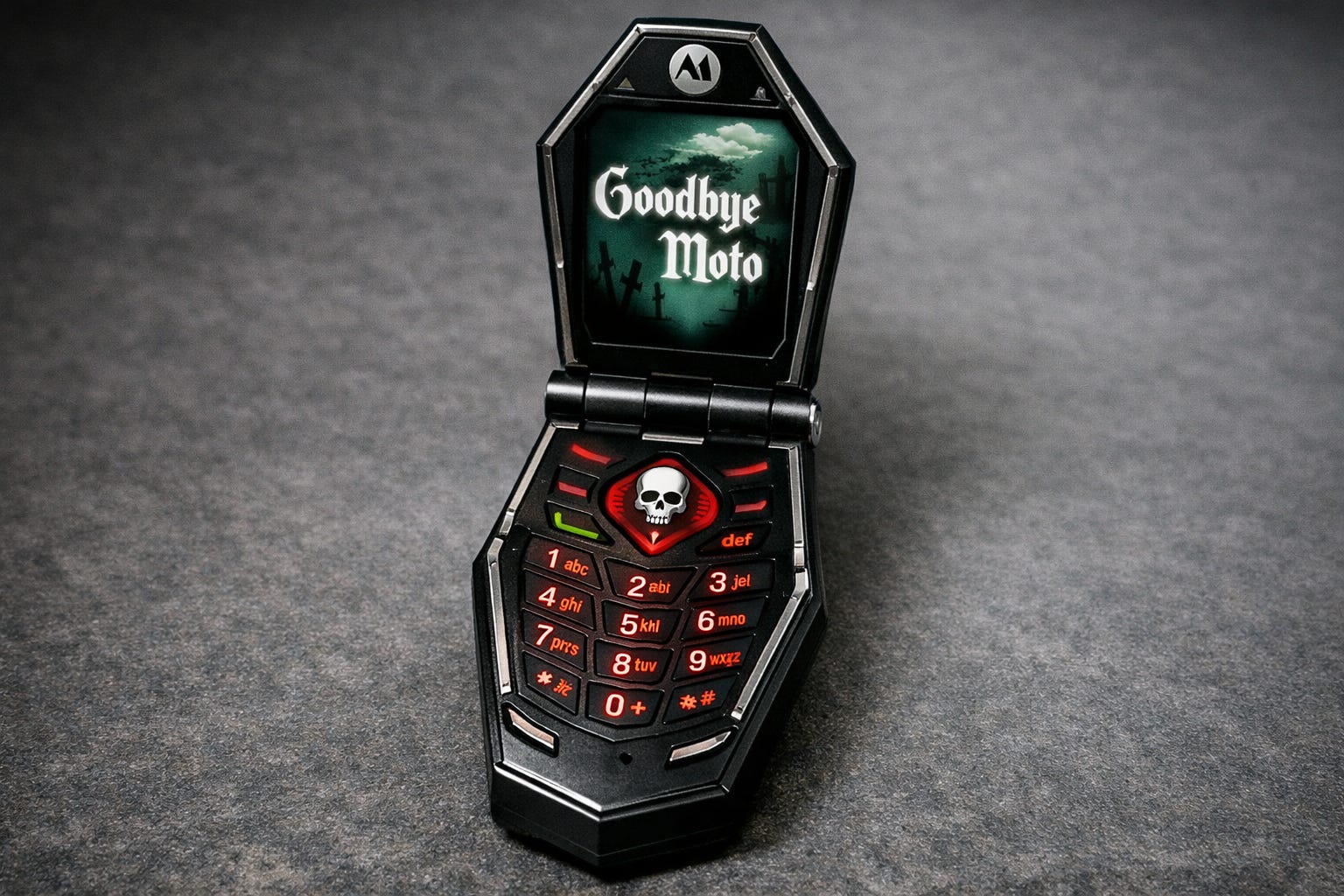
When I worked at Motorola, I was one of 80,000 employees in the handset division. Today, as a division of Lenovo, I believe the company has around 800 people. It’s quite a tumble. Looking further back, when I edited What Mobile magazine, Motorola had an unassailable market share of over 50%. There were many more players then. NEC was important, Nokia was growing fast, and Ericsson was an established rival.
Apple only made computers and the Newton. Note that I said made the Newton, not sold the Newton. It’s worth remembering that Jony Ive’s first product was a flop.
Today, Motorola has a market share of less than 4%.
More important than dominant market share was Motorola’s engineering prowess. It attracted and fostered the greatest radio, mechanical, and technology engineers you could imagine. Talk to the man who looked after displays, and it was what he ate, breathed, and cared about more than anything else. The audio guy was passionate about sound. A true hi-fi buff, he lived and breathed it. These men. Yes, sorry, these men had patents and enjoyed the freedom and budgets to do the cleverest of clever things.
When I left Motorola, I went to Sony Ericsson, where budget phones failed operators’ radio testing. Adding a frequency band to a phone was a major project. To me, this was alien. At Moto, radio skills were an absolute part of being.
Three things killed Motorola: software, process, and the loss of Geoffrey Frost. I’ve written about software before, albeit 12 years ago.
What I didn’t talk about in that piece was Process and Geoffrey. The reason Geoffrey mattered was that the process was broken. Decision-making was poor and the company structure dreadful. There was always a re-org around the corner. In the five years I was at Motorola, I had ten bosses. One supplier said that Motorola org charts should have times as well as dates on them.
Part of Geoffrey’s genius was saving Motorola from itself. He was great at seeing the future and predicted the mobile phone would become the music player of the future at a time when it only made phone calls. Geoffrey offered Jony Ive whatever he wanted, including two planes, to leave Apple for Motorola. This was before the iPhone.
Geoffrey fought back against process. I still have the T-shirt he had printed saying “Stop the madness, Moto.” I clearly remember the meeting when the board was introduced to Razer, before it became RAZR. This was a skunkworks project produced outside the process. It started as an engineering challenge from CTO Ralph Pini to make a super-skinny phone and grew into a full product.
All projects had to compete for space on the roadmap and were assessed against various metrics. A new product had to demonstrate demand from mobile operators, who bought 80% of phones. In Motospeak, “customers” were operators and “consumers”. individuals who bought and used phones. Without customer demand, a phone was dead in the water.
RAZR, a $1,000 phone, had no customer support. To pass our committee, it also had to demonstrate a target sale of three million units. All major components needed a guaranteed supply. The RAZR team gave a projected sales figure of 800,000 units, and the etched keypad could only be made by one manufacturer with limited capacity.
I later found out the team was lying about the 800,000. They actually believed it would sell 300,000 but chose 800,000 because that’s what the V70 “Hummingbird” had sold, and that had broken even.
Various VPs moved to drop RAZR. It was outside process and lacked customer support. Focus groups found it divisive: some consumers loved it, others hated it. Regional heads didn’t want to approach network buyers with a product like that.
Geoffrey pulled rank. He was Chief Marketing Officer not just for the mobile devices division but for all of Motorola. That made him more senior than the other VPs. More importantly, he had the support of the president. Geoffrey argued that divisive was good. If you had a phone everyone quite liked, there was no certainty consumers would choose it over a rival from Kyocera, Samsung, or any of the other early-2000s manufacturers. If some people hated it, that didn’t matter. They were lost anyway. What mattered was that everyone who loved it would buy it.
More importantly still, he didn’t care if it sold 800,000. He only wanted 800 units to go into the goodie bags at the Oscars, where stars would show what manufacturers had paid to give away. Having the most famous people in the world seen with a Motorola was what he wanted. And what he got.
In the end, that 800,000 proved wildly wrong. In the first three years, the V3 version of RAZR alone sold 50 million units. It went on to spawn a host of other RAZR devices, totalling over 130 million, and saved the company.
Where it all went wrong was that Geoffery died. I won’t commit the most striking story about this to my Substack, but I’ll tell you if we meet. Geoffery was proof that one man can be bigger than a business. Not as a figurehead like Alan Sugar or Richard Branson, but as someone who saved a company from itself.
Instead, we got process. Of course, we already had process. Phones were built on a planning structure called M-gates, but it got worse. We were slow. Getting a new phone from concept to shop counter took eighteen months. Samsung was doing it in nine. This was the early 2000s, when every year brought major developments in phones. Not like today, where a better vapour chamber is noteworthy. We needed to fix this, and most of all, the problem was software.
Motorola's senior management were brilliant people. Harvard MBAs. But they could be brilliant at anything: financial trading, pharmaceuticals, oil drilling. They didn’t really know, or care about, mobile. They also had a very American perspective, and back then the USA was three years behind the trends. So they did what smart MBA types do and brought in McKinsey. An obvious choice, as despite both being global, McKinsey and Motorola were Chicago companies.
The process of process logjammed everything. Anything you did had to be run past McKinsey. They looked at what caused delays in phone development and added checks to prevent mistakes.
We went from taking 18 months to make a new phone to 36. The business became so tied up in process, from both McKinsey and the religion of Six Sigma, that everything became impossible.
RAZR had been built outside process. The team behind it had a follow-up ready: the beautiful Aura.
It had a fabulous high-resolution display, a mechanism developed with Swiss watch manufacturers, and a feeling of quality and heft like no other phone, except perhaps a Vertu.
Initially codenamed GD2, it was meant to be another skunkworks project, but process had other ideas. This was a 2G phone and should have been a fast follow to RAZR. Instead, it was delayed by the need to work through multiple committees. There was a 90-minute daily call with 50 people every day except Friday. Aura took three years to reach market.
The world’s best ever 2G phone was launched into a 3G world, two years after the iPhone. Aura never stood a chance. Motorola never stood a chance.
Motorola was sold to Google, asset-striped and moved on to Lenovo.
Some of the engineering brilliance still peeks out from time to time, but last time I tried to deal with the company my project got killed by process.
The thing I remember most about the RAZR team was the way that they closed up shop for their "regular work" around 5PM and then started working on RAZR from 5PM into the early morning hours. Skunkworks projects lived all across Motorola in the late 90s and early 2000s, and then to your point, process killed it all.
Well, that and a head of a mobile phone business who famously answered the question "what's next for Motorola after RAZR?" to which he responded "More RAZRs!" Smh. Drove that one right off the cliff until what once was a premier product that David Beckham was the face of - to a product where you got four RAZRs for 2p on a 2 year contract with T-Mobile. Meanwhile, the step change technology of 2G to 3G where Motorola had an early lead with big contracts from 3 and Vodafone was frittered away.
I liked this a lot. It made me feel nostalgic for her early 00s.
We kind of crossed paths back then, I think, as I was the person behind the Pogo mobile, and a few people at the The Register were very supportive of a small team with a vision up against the big boys.
In our case, it was less the software, hardware and ID (which is all we did), more our naivety at understanding how the market worked. When we finally got a carrier deal, the hoops we had to jump through reduced our offering from a "cloud based" (the term didn't exist at the time) personal device with full web access, email, MP3, etc. to a WAP device playing Java games. In effect, we transitioned from the "consumer" - the person we thought would love the device, to the customer - the network operator - and they had no idea what people wanted, or could be made to want.
I found it amazingly frustrating that we'd send out devices for evaluation and could see from the logs the network operator executives using them all night (surfing all sorts of nefarious websites), running up mobile data bills of £100s, not returning them for weeks as loved them so much, but then wouldn't cut a cheque as it wasn't part of the "strategy". A strategy, I might add, that within 5 years reduced them to utility pipes and handed their customers to Apple and Google.
People sometimes ask me if I'm bitter at seeing everyone armed with a smartphone now, knowing we had it right 5 years before Apple. The answer is: no, not really. It just makes me feel like we were in the right path and had the right vision, but we're dealing with an industry that didn't know it was doomed, and so wasn't ready for a lifeboat